29 Sep 2026
Video
- Community & News
- Service Line
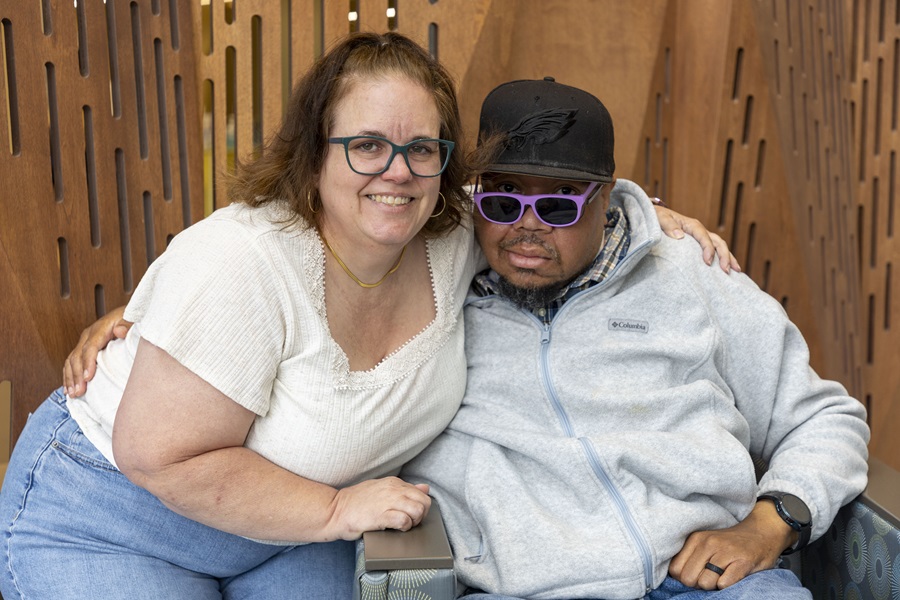
Watch Ali and Tye share their story
Stroke symptoms don’t always look quite the same. In some cases, the traditional guidelines of BE FAST—noticing issues with one’s balance, eyesight, facial expressions, arm strength or speech annunciation and recognizing it is time to seek care—can’t always provide the full range of presentation.
This made it all the more crucial that Tye Mitchell’s family acted when they did after noticing he seemed a bit “off” at a Mother’s Day gathering. Although Tye’s symptoms weren’t identified as BE FAST indicators, his loved ones knew him well enough to know that action had to be taken and getting him an ambulance to TriHealth’s Good Samaritan Hospital.
“He ended up going to Good Sam. We found out that he had three small strokes,” said Tye’s wife, Ali, before reiterating Tye’s lack of traditional symptoms: “To me, a stroke meant paralysis, bell’s palsy… he didn’t have any of that.”
It turns out it wasn’t just the symptoms of Tye’s stroke that was uncommon.
“He has stage 3 kidney disease… his kidneys caused the blood pressure, which caused the strokes,” Ali explained on Tye’s behalf.
Ali speaks on Tye’s behalf a lot for the moment, including the majority of this interview—but Tye does speak a bit when he feels inclined, which is already more than it was directly after the stroke.
Short-term memory has been an area of focus and improvement so far in the rehabilitation process.
“He remembers a lot of things, but learning new skills, trying to go back to work, get a job—will be challenging,” Ali says.
Despite the challenges so far, Ali has gotten a lot of hope out of the progress Tye has made and the support she has received.
“Being at TriHealth and having the care that he got… I feel like I was part getting care too,” Ali said. “They definitely cared for me and gave me some of the tools we use at home now to help with the rehabilitation.”
In addition to the at-home rehab Tye and Ali do, they’ve also been working with the folks at the TriHealth Rehabilitation Hospital, starting with the simple things many people often take for granted.
“They have an apartment setting where he worked with an occupational therapist on how to get in and out of the bathtub, how to brush his teeth,” Ali said of those important aspects of independence and self-care.
The Mitchells are seeing promising strides in Tye’s improvements, and they’re marking down every win.
“Getting out of the hospital was a milestone,” Ali said of Tye’s early days recovering. “Then walking… he took the dogs for a walk probably two weeks after he had been home, which was exciting.”
Tye’s progress so far gives his care team and family a lot of hope that he will continue to improve.
“He now wants to do more activities,” Ali said, smirking. “They made the mistake of telling me… that being in social environments is good. Now, it’s the weekend, and he wants to GO!”
The Mitchells have also not let this keep them from living and having fun. Tye’s love of social environments and staying active is keeping the two of them busy.
“The first time we went bowling was shortly after we got home, and he bowled really well,” Ali said. Seeing that display of independence from Tye was reassuring, not only to Ali, but his family, who had been supportive and involved the entire time. “His whole family was there, everybody was cheering and they were all excited—because they had seen him before.”
Ali’s confidence in the future is rooted in the progress Tye has made so far, something she credits in part to the care team at TriHealth.
“I don’t think we would be where we are if we wouldn’t have had the care and the guidance and the personalities that we dealt with at Good Sam and at the TriHealth Rehab Center,” Ali says. “The biggest thing we would say to them is just thank you… thank you for making us feel comfortable, making us feel loved, and just loving on my husband.”
Learn more about stroke care with TriHealth Neuroscience Institute today.