Kangaroo Care Keeps Mom and Baby Close After Birth, Improves Health Outcomes
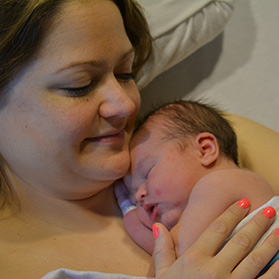
The first moments after childbirth may be some of the mostemotional in a mother’s life. After nine months of carrying the child, anaverage of six to 12 hormone-fueled hours of early labor followed by up toeight hours – or more – of active labor and pushing, many mothers’ naturalinstinct is to hold their baby close.
But traditional obstetric practice has not always catered tomoms’ instincts, instead calling for baby to be whisked away to a warmer forprolonged assessment, or swaddled and handed off to an anxious father orgrandmother.
A maternal care philosophy called Kangaroo Care, which keeps mother and baby together, skin-to-skin, forthose first precious hours after childbirth, is challenging traditional hospital birthing routines.
“Physiologically, there is a lot to be gained by having momand baby together,” said Dr. Betsy LeRoy, an obstetrician with TriHealth SamaritanObstetrics and Gynecology. “For the baby, who may be having a little difficultytransitioning into the world, showing respiratory issues and temperature deregulation– by having mom there, soothing and calming that stress response, we’ll seethose babies transitioning better.”
LeRoy cited research showing that reuniting mom and baby skin-to-skinat the time of birth produces lower rates of complications, lower rates of NICUadmission, higher successful rates of breast-feeding and lower stress hormoneresponses in both mother and child.
“The way I look at it as an obstetrician is that mom isnature’s warmer,” LeRoy said. “That’s where that baby is meant to be at thatpoint.”
The normal routine of assessments still take place underKangaroo Care, as well as the initiation of breast-feeding within the firsthours after birth. But unlike traditional neonatal care models, the baby neverleaves the mother’s chest.
Despite the emphasis on immediate bonding time betweenmother and child, LeRoy pointed out that Kangaroo Care isn’t about devaluingthe role of support persons, or preventing them from being involved in thebirthing process. It just means that mom’s partner, sibling or parent will haveto wait an extra hour or two before holding the newest member of the family.
LeRoy says that she’s been employing Kangaroo Care practicesfor years, but TriHealth’s widespread adoption of the model will set the healthcare system ahead of the curve in the local market.
“TriHealth is leading the way in innovations that make thechildbirth experience more pleasant for everyone involved and healthier foreveryone in the end,” LeRoy said.