Returning to School: A Transformative Experience
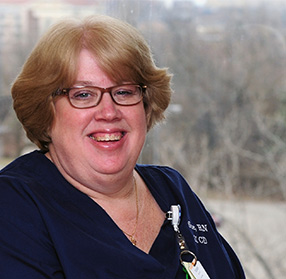
Don’t get Michael Mullen, BSN, RN, ED educator at Good Samaritan, talking about Good Samaritan College of Nursing and Health Science (GSC) unless you have plenty of time on your hands.
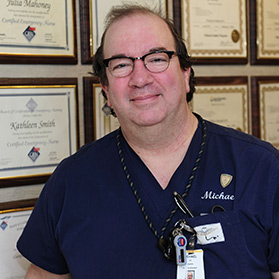
Michael Mullen
“I was not excited about getting my BSN,” he says, recalling his supervisor suggesting he go back to school. “I’d been a very successful nurse for over 25 years, and I really didn’t think there was much for me to learn.” During his very first class at GSC, that opinion changed.
“When Teresa Getha-Eby (BSN Program Director at GSC) walked into the room, we all became silent. We sensed a compelling gravitas about her as she introduced herself. They say, ‘When the student is ready, the teacher appears.’ In that moment, I knew I was in the right place.”
It wasn’t just Getha-Eby who got his attention. “All the profs were very collegial,” says Michael. “They build enduring relationships with their students. I now have professional relationships with all of them and I could go to any one of them with any problem I might be having.
“Getting my BSN changed the way I think and gave me a new foundation on which to build the rest of my career. Learning about research, theory, and changes in nursing – I went from being a grouchy old curmudgeon nurse to ‘Oh my God, this was fabulous!’ I have new eyes now and a new vision. I am very grateful to all my teachers at GSC for being patient with me and helping me to earn my degree. For me the entire program was like a religious experience and I now tell people I feel like a ‘born again’ nurse," he says.
“There’s a saying ‘You know you’re getting older when your memories become more important than your dreams,’ but the professors at GSC taught this old nurse how to dream again, and I will be forever grateful," Mullen concludes.
Overcoming Obstacles
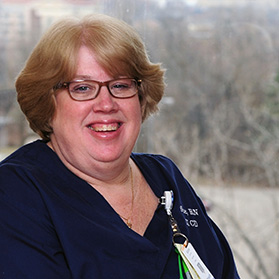
Sue Martin
Sue Martin, RN, charge nurse, Telemetry, Good Samaritan, is counting the days until graduation. She returned to GSC at age 54, 34 years after receiving her diploma at Good Samaritan Hospital School of Nursing.Good Samaritan College of Nursing.
Sue knew she needed to get her BSN to keep her position as charge nurse on GSH Telemetry unit. “I realized I had another 10-15 years before I retired and I needed to keep myself marketable.”
One of the biggest challenges she faced initially was technology. “The faculty really listened to those of us who found the technology piece so hard. They made changes that helped,” says Sue.
Sue and her husband raised five children who are now in their 20s, and she says “it’s been a collaborative family project to get me through school.” A son is a nurse in Milwaukee. “We are having a race for how many initials we can get behind our names,” she says with a laugh. Sue looks forward to adding BSN to the list.
Small Classes, Personal Attention
Both Sue and Michael stress the benefits of the personalized attention they received. “Part of the joy is that in small classes you can build a relationship with the professor,” Sue says. “I’ve known many of them as colleagues. They really know where we’re coming from.”
Relationships with other students were also important for her. She recounts how on one team project she was part of a group with a student in each decade from 20s through 50s. “I hope someone reading this right now will decide to go back to school. But when you do, get ready because your life is about to change!”