New CT Scanners Cut Radiation Dose: What This Means For You
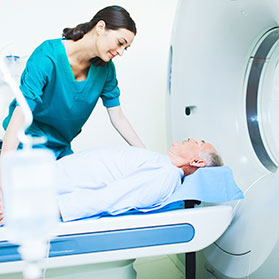
If you’re scheduled to undergo a CT scan in the near future and have concerns about radiation exposure, there’s good news: An expansive program enacted by TriHealth’s Department of Imaging is cutting CT doses by up to 60 percent.
TriHealth has replaced six of its aging CT scanners and adopted new software and standards to ensure that each scan uses the lowest dose of radiation required to obtain a perfect image.
It’s not that the older scanners weren’t doing their jobs, according to Don Owens, manager of imaging at Bethesda North, but that “there are so many technical advantages that we weren’t taking advantage of.”
“It’s about getting the right dose for the patient,” he said, noting the improvement over older methods, in which a patient weighing 100 pounds would likely be prescribed the same dose as one weighing 300 pounds.
Of course, the risks associated with radiation exposure at the levels obtained from medical imaging are low enough that they can’t be reliably measured. Still, anxious patients can rest easy knowing that this already safe procedure has been made even safer thanks to proactive efforts by TriHealth.
While TriHealth’s radiologists and imaging technologists are going through training to adjust to the new equipment and standards, Owens says the patient experience remains as simple as ever.
“Nothing would change for the patients,” he said. “They would see nothing different.”
Working closely with manufacturing giant Siemens, TriHealth is the first health care network in the U.S. to participate in Siemens’ Optimize CARE CT program, a service that provides imaging technologists with a suite of useful data to help minimize radiation doses while retaining quality.
TriHealth has also become the first large network to partner with Imalogix and use their dose-tracking software, according to Brandon Young, manager of imaging at Good Samaritan.
“They were very responsive to our suggestions,” Young said. “This partnership allowed us to get exactly what we wanted and it allowed them to improve their product – it was a win-win.”
As part of the Optimize CARE program, three new Siemens scanners were installed at Bethesda North, while two more were installed at Good Samaritan Hospital. Another scanner was replaced at Arrow Springs.
TriHealth is also employing Siemens’ SAFIRE software to match patients with the appropriate radiation dose. The new software enables hyper-accurate dose tracking on any scanner, and can notify doctors when a dose exceeds a set threshold.
Owens says that while most patients aren’t too worried about the processes at work during a CT scan, those who have done some research tend to be the most inquisitive.
“Some patients are very well informed, Owens said. “They ask how much dose they will receive and if that dose is safe.”
One way to put patients at ease, he says, is to compare the radiation dose of a CT scan with other commonplace exposures. For example, a CT head scan generally requires a dose equivalent to about three months of natural ambient radiation, or 40 trans-oceanic flights. At 2 millisieverts, the radiation dose for a head scan falls well within the Nuclear Regulatory Commission’s annual dose limit of 50 mSv.
In other words, even a patient scanned with the old equipment and standards would have little to worry about in terms of radiation dosage. Now, under the new program, most patients can expect to receive between 14 and 50 percent less radiation per dose, depending on the scan target.
TriHealth’s early adoption of dose reduction measures set the network on track to meet federal regulations taking effect on Jan. 1, 2016.